




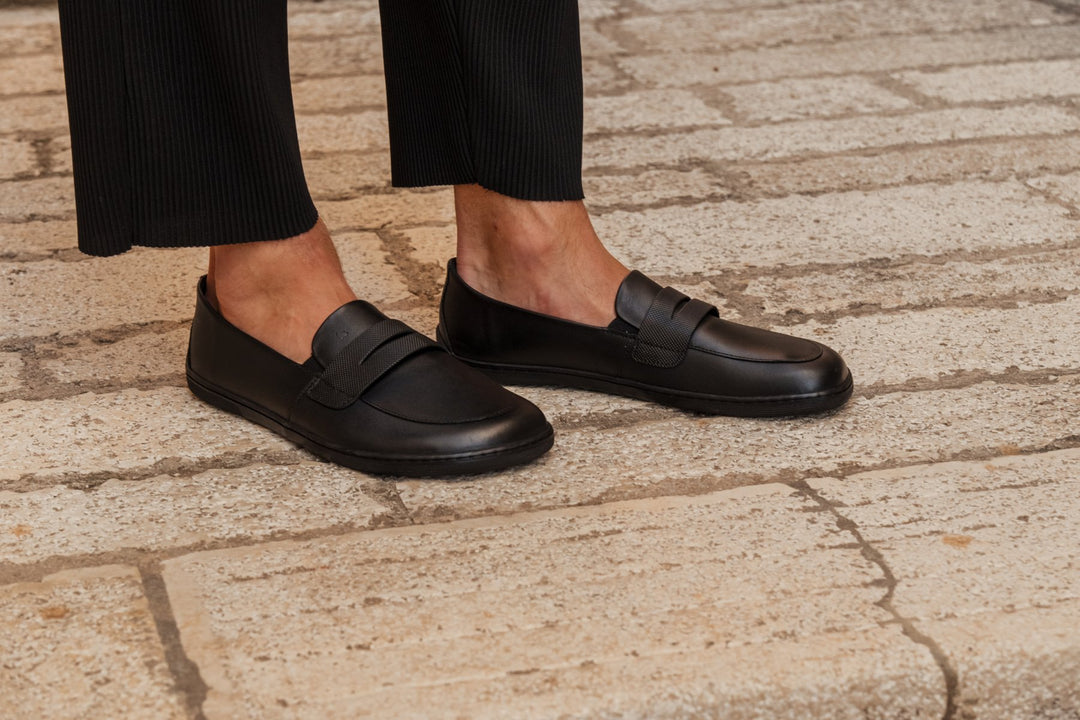


Standing all day can be hard on your feet, knees, hips, and lower back, especially on concrete, tile, or other hard floors.
Most work shoes try to solve that with thick cushioning, arch support, and a raised heel. That can feel helpful at first, but it also changes how your body stands and moves.
- a raised heel shifts your weight forward
- narrow toe boxes crowd your toes
- and stiff soles limit how much your feet can do naturally
Barefoot shoes take a different approach.
Instead of forcing your foot into a fixed shape, they give it more room to function the way it is meant to.
- a zero-drop sole keeps the heel and forefoot level
- a wide toe box gives your toes space to spread
- and a flexible sole allows more natural movement
That does not mean every barefoot shoe is a good choice for long shifts.
If you work 8 to 12 hours on hard floors, a very thin and aggressive model can be too much, especially if you are new to barefoot footwear. In most cases, the better starting point is a shoe that keeps the main barefoot features but feels practical enough for all-day wear.
This guide covers:
- what to look for in a barefoot shoe for standing all day
- which brands make the most practical options for work
- which models are worth considering
- how to transition without making your feet more sore
Our Top Selection


Xero Prio All-Day SR
Practical slip-resistant model for workplaces where grip matters.
Explore Xero Prio All-Day SR

Read more below about why we recommend these shoes.
Our Background with Barefoot Footwear
Martina works with barefoot shoes every day in our Sydney store and regularly helps customers compare brands, shapes, and fits in person. She sees which models are easier to tolerate on hard floors, which ones work better for high-volume feet, and which shoes make the most sense for long hours on the go.
This guide is based on practical fitting experience and general barefoot footwear principles.
Quick Disclaimer: We are not doctors, podiatrists, or physiotherapists. This article is for general information only and is not medical advice. If you have ongoing foot pain, plantar fasciitis, back pain, injuries, circulation issues, or other concerns, it is best to speak with a qualified health professional.
When Barefoot Shoes Make Sense for Standing All Day
Barefoot shoes may make sense if:
- you stand for long hours and your current shoes still leave your feet feeling tired, cramped, or restricted
- you want more toe space and a more natural fit than regular work shoes usually offer
- you prefer a flatter, zero-drop shoe instead of a raised heel
- you want your feet to move more naturally instead of being held in stiff shoes all day
- you are open to a gradual transition
- you can choose a model that suits your workplace and the surfaces you stand on
Barefoot shoes may not be the best option if:
- you want to switch straight into full-day wear without building up gradually
- you choose a very thin model for long shifts on hard floors
- your workplace requires slip resistance or other safety features that the shoe does not provide
- you already know that minimalist shoes feel too harsh for long periods on concrete or tile
- you expect barefoot shoes to feel like soft, cushioned work shoes
Our tip: For standing all day, it usually makes more sense to start with a model that offers a bit more comfort on hard floors rather than the thinnest option available.
What to Look For in a Barefoot Shoe for Standing All Day
- Enough internal volume – if you stand all day, your feet may swell. The shoe should not just be wide at the toes, but also comfortable through the upper.
- Enough protection from hard floors – for concrete or tile, a slightly more cushioned barefoot shoe is often a better choice than a very thin one.
- Flexibility – the sole should still bend and move naturally rather than feeling stiff.
- Slip resistance if needed – if you work in healthcare, hospitality, retail, or other environments with wet floors, grip can matter just as much as comfort.
Our tip: Tight socks can undo some of the benefit of a wide toe box. Softer, roomier socks or anatomical toe socks can feel better during long shifts, especially when your feet heat up and swell.
How Top Barefoot Brands Compare for Standing All Day
- Barebarics: One of the strongest options for long standing on concrete. Usually offers more stack, more volume, and a more approachable feel than thinner barefoot brands.
- Xero: Practical and durable. Some models work especially well if you need a more occupational or slip-resistant option.
- Be Lenka: Very foot-shaped and often wide, but some work-friendly models are still quite thin underfoot. Better for people already somewhat adapted.
- Vivobarefoot: Premium and highly flexible, but often too minimal for beginners standing all day on hard floors.
- Koel: A nice middle ground if you want something stylish and not overly bulky.
- Splay: Great value and a very roomy forefoot. Best for casual settings rather than stricter workplaces.
Our Top Barefoot Shoe Picks for Standing All Day

Barebarics Zing
- A very strong all-round option for hard floors.
- More substantial sneaker feel compared with thinner minimalist shoes.
- Good choice for casual everyday workwear.
- Works well if you want a foot-shaped shoe that still feels practical for long shifts.

Barebarics Revive
- A strong option if breathability matters.
- Roomy Barebarics fit with a lighter, more breathable upper.
- Works well for active workdays or warmer conditions.
- Useful if you spend long hours moving between indoor and outdoor settings.

Xero Prio All-Day SR
- The most practical pick here if your workplace includes wet floors or you specifically need slip resistance.
- Built more like a true work shoe than a casual barefoot sneaker.
- Good fit for healthcare, hospitality, restaurant work, or retail settings where traction matters.
- Balanced option for people who need grip as well as a more natural fit.

Xero Dillon
- A good option if you want a cleaner, business-casual look.
- Works well as an entry point for people who want something simple and work-appropriate.
- Suitable for standing desks, light retail, and client-facing environments.
- The main thing to watch is width, as it may not be roomy enough for very wide or extra wide feet.

Xero 360
- A better match for more active work.
- Good if your day involves standing, lifting, walking, or changing direction often.
- Offers a secure midfoot fit.
- Works well for people who want something stable for busy shifts.
A Quick Comparision
| Model | Best for | Feel on hard floors | Slip resistant |
|---|---|---|---|
| Barebarics Zing | Concrete, long shifts | More forgiving | No |
| Barebarics Revive | Active long shifts | More forgiving | No |
| Xero Prio All-Day SR | Healthcare, hospitality | Balanced | Yes |
| Xero Dillon | Office, standing desk | Moderate | No |
| Xero 360 | Active work | Balanced to protective | No |
The Ultimate Transition Protocol for Occupational Standing
Important note: Do not switch straight into a full 8- to 12-hour shift in a thin barefoot shoe. That is one of the fastest ways to overload your feet, calves, or Achilles.
Phase 1: Start Small
Begin with short periods.
That might mean:
- 20 to 30 minutes at home
- short errands
- 2 to 3 hours of your shift before changing shoes
If needed, keep using a flat zero-drop insole during this stage.
Phase 2: Build Gradually
As your feet adapt, slowly increase the time.
A gradual increase works much better than forcing long hours too soon. Some mild fatigue is normal in the early stage, but sharp pain, increasing heel pain, or next-day soreness that clearly worsens is a sign to scale back.
Phase 3: Full-Day Use
Once your body handles the load well, you can build toward full workday wear.
For some people, this may take a few weeks. For others, especially if they are new to barefoot shoes or stand for long hours on concrete, it may take several months. That is normal. Standing all day is a demanding use case, so slower is usually smarter.
Final Thoughts
Standing all day is one of the harder use cases for barefoot shoes. The best option is usually not the thinnest model, but the one that gives you enough space, flexibility, and comfort for the surfaces you are actually on.
Based on our fitting experience:
- Barebarics Zing is one of the safest starting points for concrete and long shifts.
- Barebarics Revive is a strong alternative if you want something more breathable.
- Xero Prio All-Day SR stands out if slip resistance matters for your job.
- Xero Dillon suits cleaner business-casual settings.
- Xero 360 makes more sense for active work.
The best choice depends on your work environment, how adapted your feet already are, and what your day actually looks like.
If you choose the right model and build up gradually, barefoot shoes can be a practical option for standing all day without relying on stiff, raised, heavily structured footwear.


